Safe concrete cutting and silica rules for Bristol crews
Cutting concrete, stone and block produces a fine dust that contains respirable crystalline silica, and that dust is one of the more serious hazards a concrete crew faces. The particles are small enough to reach the deepest parts of the lungs, and repeated exposure can cause silicosis, a scarring disease for which there is no cure, as well as lung cancer and other illnesses. The risk is not confined to professional crews. A homeowner who grinds a patio or cuts a paving slab with a disc is exposed in the same way, and the controls are the same. This guide explains the health effects of silica, the water suppression and extraction that limit the dust, the respiratory protection that completes the control and the duties that apply under COSHH.
The health effects of silica
Silica is a natural mineral found in sand, stone and many building materials, and concrete contains it through its aggregate. When concrete is cut, sanded or carved, the process releases particles of crystalline silica into the air. Those that are small enough to be breathed deeply can lodge in the lungs and cause damage over time. The Health and Safety Executive's guide for employees, Control of exposure to silica dust, explains that the harm comes from breathing in the dust, and that silicosis usually develops after at least ten years of exposure, often with no symptoms at first. The HSE's page on silicosis adds that the disease continues to develop after exposure has stopped and is irreversible.
The symptoms can take many years to appear. A worker who feels well after a season of cutting may still have damage that shows only later as a cough, breathlessness or a change on an X-ray. For that reason the control of exposure matters, even where no symptoms are present. Silicosis cannot be reversed, so the only effective response is to stop the exposure before the damage builds up.
Water suppression and extraction
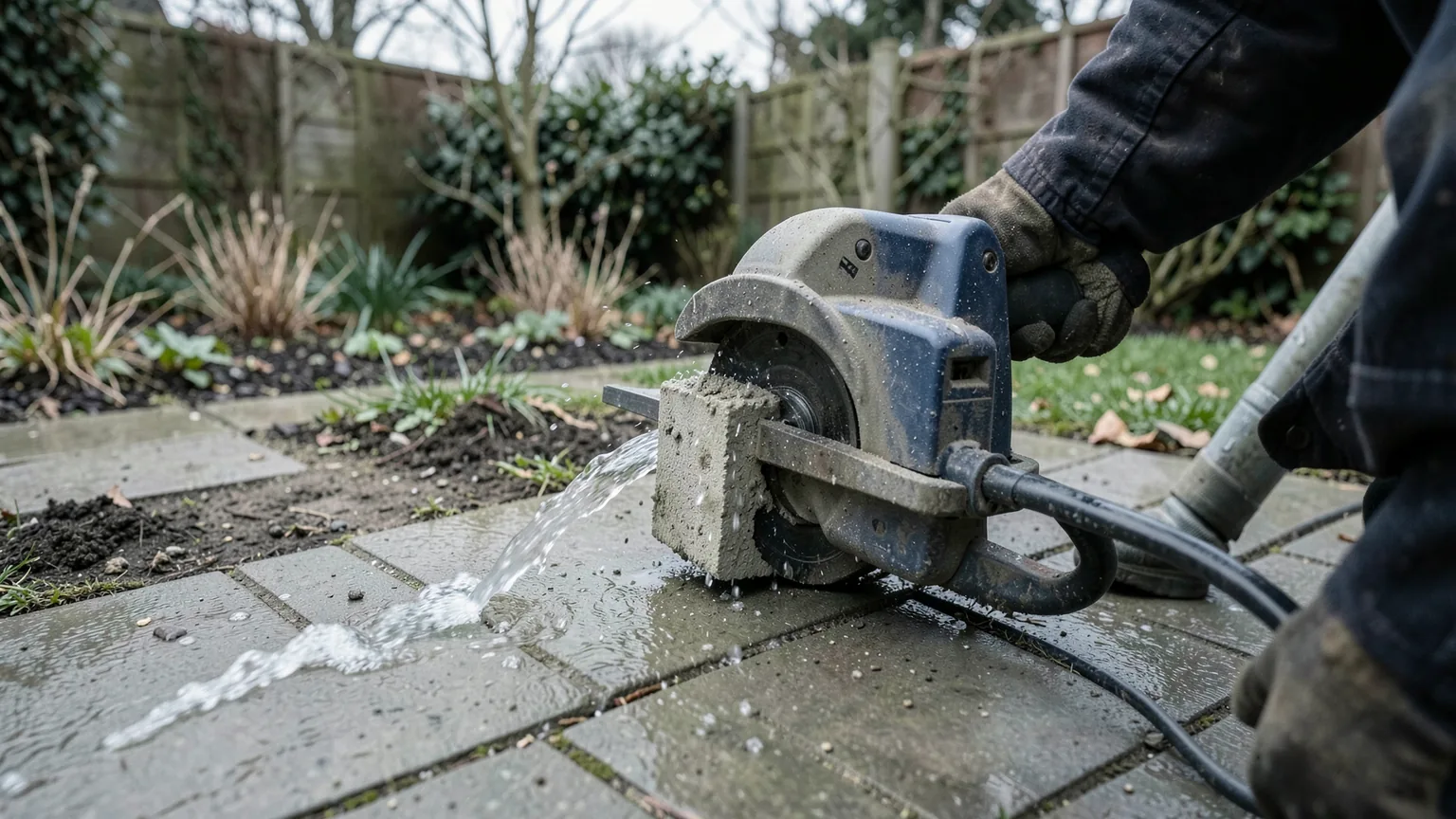
Water is the simplest and most effective control for cutting concrete. Wet cutting keeps the dust down by binding the particles and washing them away, and it reduces the amount that enters the air. A saw with a water feed, or a supply of water poured directly onto the cut line, should be used wherever the task allows. Wet cutting is not a complete control on its own, because the slurry it produces must be managed, and the surface must be kept wet throughout the cut.
Where wet cutting is not practical, extraction removes the dust at source. A dust extraction unit connected to the tool captures the particles before they reach the operator's breathing zone. Extraction performs well when the tool, the hose and the filter are matched and maintained, and a filter that is clogged or the wrong size lets much of the dust escape. Dry sweeping and blowing with compressed air should be avoided, because they raise the dust into the air. Where dust must be cleaned up, a vacuum fitted with a suitable filter is the correct tool.
The control chosen should match the job, the material and the amount of cutting, and the assessment should be reviewed whenever the work changes.
Respiratory protective equipment
Respiratory protective equipment is the last line of defence, and it should be used alongside the water and extraction controls rather than instead of them. A suitable respirator must fit the wearer's face properly, and the fit should be tested, because a loose mask allows dust to bypass the filter. Facial hair that breaks the seal reduces the protection the mask offers, and the respirator must be chosen to match the level of exposure the assessment has identified.
Respirators are often the first control that a worker reaches for, and they are often the least effective when used alone. The correct order is to control the dust at the source first, then to limit the time spent in the dust, and finally to protect the worker who remains in it. A crew that relies on a mask alone is not controlling the hazard.
The duties under COSHH
The Control of Substances Hazardous to Health Regulations 2002 apply to silica dust, and the regulations are set out in full on legislation.gov.uk. Under those regulations, an employer must assess the risk from silica dust, decide the controls needed, make sure they are used and maintained, and provide training and information. The HSE's COSHH pages explain how these duties apply in practice, including the use of workplace exposure limits.
Silica has a workplace exposure limit, which is the maximum concentration in the air that a worker may be exposed to over a set period. For respirable crystalline silica the limit is 0.1 mg/m3 averaged over eight hours, and the HSE's guide for employees says the controls must keep exposure below it. The employer must monitor exposure where the assessment requires it, and must keep records of the results. Health surveillance is also required where the assessment shows that workers are at risk, and the surveillance should be arranged with a suitably qualified professional.
Practical steps on a Bristol job
Cutting concrete on a domestic job can be done safely with a few simple habits. Plan the cut so that it is made with water wherever possible. Use a saw with a water feed or keep a supply of water at the cut. Keep the work area wet while cutting, and clean up the slurry rather than letting it dry. Where dust cannot be avoided, wear a respirator that fits properly and is suitable for the level of dust. Keep bystanders and pets away from the cutting area, and avoid cutting in an enclosed space where the dust cannot disperse.
For a larger job, a written assessment is the right tool. It should identify the cutting tasks, the controls for each, the respiratory protection needed and the arrangements for cleaning up. The assessment should be shared with the crew and with any subcontractor, because a subcontractor who is cutting on the same site creates a dust exposure for the others.
Questions to ask a contractor
A quote for cutting or grinding concrete should state the controls. Ask the contractor whether the work will be wet cut, what extraction is used, what respiratory protection is provided and how the slurry and dust are cleaned up. A contractor who cannot describe these controls has not considered the hazard. The guide on spotting missing items in a Bristol concrete quotation explains why items such as cleaning and protection are often omitted from a quote and how to bring them out.
Where the cutting fits in the wider job
Cutting is often needed for a joint, a channel, a drain or a make-good around a boundary. Plan the cutting before the concrete is placed, so that the need for dry cutting on the finished surface is reduced. A cut made into fresh concrete is often easier and produces less dust than one made into hardened material. The sensible sequence is to plan the cuts, to set the saw up with water and extraction, and to complete the cutting in a single session.
Conservation areas and listed buildings can limit the choice of cutting method, and the guide on concrete works in Bristol conservation areas explains the planning checks that apply. The services page describes the concrete work covered on this site, and the quote page can be used to ask for a quote that states how the dust will be controlled. Silica dust is a hazard that can be managed completely, but only if it is planned for from the start.
Keeping the dust out of the house and the street
Dust from cutting does not stay where the saw is. Fine particles can drift into a house through open doors and windows, settle on neighbouring property and be carried along a terraced street on the wind. For that reason the controls should cover not only the operator but also the surroundings. Close the doors and windows of the rooms nearest the cutting, cover any vents, and keep the cutting area clear of people who are not wearing protection. Where a neighbour's property is close, a short conversation before the work begins avoids complaints and lets the crew explain the controls that are in place.
Cleaning after the cut is as important as the cut itself. Wet slurry should be removed with a wet vacuum or a damp cloth rather than swept, and any dry dust that has settled should be collected with a vacuum fitted with a filter suitable for the material. Discarded slurry must be disposed of lawfully and must not be washed into a drain or a watercourse. The guidance on controlling dust from concrete work is the reference for these steps, and the employer's written assessment should record them so that every member of the crew follows the same procedure.
Sources and further reading
- Control of substances hazardous to health (COSHH) (Health and Safety Executive)
- Control of Substances Hazardous to Health Regulations 2002 (legislation.gov.uk)
- Control of exposure to silica dust: a guide for employees (INDG463) (Health and Safety Executive)
- Silicosis: causes and risk controls (Health and Safety Executive)